Tuesday, 28 June 2016


The Imp of the Mostly Perverse
OK let me get one thing out of the way at the start: I am
one of those awful people who did not vote in the EU Referendum. I was away in
Florida on business and I basically lack the organisational skills to figure
out whatever it is you have to do to make a postal vote happen.
Another reason I felt it wisest to spare you my vote was
some of the ideas being put forward by my personal Imp of the Mostly Perverse.
You see I am on principle a floating voter. I might be that
I nearly always vote for the sensible, good-person choice, but I make it a
principle to march into the polling station arm in arm with my IMP and make my
choice only when I am right there in the booth.
I’m a firm believer in the principle of the secret ballot
but I may as well tell you these choices usually involve some kind of Lib Dem,
or an independent where one is available, or people I know and respect as being
right for whatever the job is. Sometimes I may even vote for one of the more
independent-minded Labour types. At the recent London Mayoral election someone
on line had suggested that London was in a Christian country and could not
possibly have a Muslim mayor. Being a proud secularist I left the Imp of the Mostly
Perverse firmly at home and went straight round there to vote for the only
candidate I could sensibly have chosen in the first place (I would have
preferred David Lammy, who lost in the Labour primaries; not because I always
agree with him but because I felt he was the only candidate with the kind of
large personality that London needs; but maybe an unassuming pragmatist is what
London needs sometimes).
With the EU Referendum coming up, my political IMP had a
couple of interesting ideas that might have swung things to an “Out” vote. Not necessarily
in Britain’s interests.
One of the IMP’s ideas is one I’ve been sounding off about
for a long time, which is that by joining the EU, Britain effectively turned
its back on a whole community of nations with which it shares not only a
language but also the full range of educational and professional
qualifications, the Commonwealth. Why should Kenyan tea or New Zealand butter
or Zimbabwean beef have to go through all the same EU trade hurdles as any
other country in the world, in order to access UK markets? Those arguments
about the curvature of EU bananas were not as trivial as they sound, since a
strange number of EU territories are somewhere in the tropics but are also
pieces of France by means of some little understood geographical alchemy. So
the rules favour French bananas over those of Britain’s neglected Commonwealth
friends and relations.
Why for that matter, should it be easier for Romanian or a
Lithuanian nurse to work here, than a Zimbabwean or a Ghanaian? I'd happily see both, but surely the folks who come from our world are an easier fit for many roles?
It has always been my belief that easier movement of both
trade and people with the exciting and fast-growing nations of the Commonwealth
would be to everyone’s benefit. Trade would aid the growth of many of those
countries far more effectively than aid does.
I grew up in one of those countries myself, Zimbabwe – and with
British parents I am not untypical of the mix of people and cultures that comes
out of that world. When I came to this country as an adult in 1981 I found the
British attitude to us small-minded and dismissive. In Zimbabwe the sense which
many of us had was that a colony becoming independent was kind of like a child
growing up and leaving home (I daresay this view was not shared by all of my countryfolk but it was there). The British attitude, at least from
those few English people I met when I first arrived in London, was that if
those countries did not “want” Britain any more then good riddance to them.
I do not know if British attitudes have improved since then,
though I suspect they have. Nor was it clear that this Brexit referendum was
the time to unpack something I had long considered to be a lost cause, a
historical mistake and nothing more.
Interestingly, there were vox pops on the
news articulating this viewpoint, and it may have accounted for the close
result in Birmingham – but there was no-one in the political campaigning who
took ownership of this idea. If there was, this would have immediately repudiated the notion that to vote for Brexit you had to be a racist, since this approach would tip the balance away from seeing more immigrants of European ethnicity, and towards those who have shared in some part of our proudly long and diverse history but only a few of whom are ethnically European.
Were the British now big enough to take ownership of a new,
positive relationship with the Commonwealth by now? I didn’t know. Who was I to tell
the British who they are?
While this first of the Imp’s ideas has Britain’s interests
at heart, the second was rather more brutal. I’ve seen how Europe works as a great, vibrant, interconnected thing. I can see that it needs to
be more integrated to reach its full potential - it was clear from the outset
that you can’t have one currency without a more formally federal kind of
government and more centralised monetary policy. Other recent challenges faced by the EU have served to reinforce this point.
It is equally clear that Britain a a whole cannot and will not ever be
part of such a unified project. In terms of whatever is that elusive something that
holds Europe together, Britain is about as European as the Valles Marineris.
So one thing I would seriously have to think about as the
pencil hovered over the ballot sheet was, is Britain’s continued presence in
the EU something that will make it easier or harder to move the European
project forward? As someone who wants Europe to succeed, my IMP would be asking which option is best?
As it turns out, the deal that Cameron worked out in the
run-up to the referendum was one which would allow Europe to pursue greater
integration without Britain standing in the way. An option, incidentally, which
expired the moment the Referendum vote was known – so those who are pushing for
a reversal or a re-match, are missing the fact that any future British
membership of the EU would not be on the special, one-off basis that Britain
had always had and was set to continue with.
So that would have taken care of this one of the IMP’s ideas
– but again why was this not part of anyone’s political campaign? There must be
many voters who would want to be reassured about what would make for a strong
Europe as a trading partner on our borders.
As with the Commonwealth so with Europe: what if anything is
Britain’s vision for it and its place in relation to it? And who am I to tell the British who they are?
So I basically recused myself on the basis that I was
curious to see who the British thought they were, and in order to make sure
that my Imp of the Mostly Perverse was safely out of harm’s way in the swamps
of Florida when the time came.
This was all on the back of a kind of complacency that in
the end, the British would vote for whatever they were least happy with so they
could carry on grumbling about it.
I was wrong as well as unkind in thinking this.
I also failed to spot that, as someone who is sort of half from
somewhere else, I am basically your typical Londoner and had every right to
vote for my own interests and my own vision of things, whether people out there
in the Shires shared those views or not. I passed up on the opportunity to be
me, someone who has shared in the life of these islands for longer than a lot
of their people have been alive.
There was a third possible and non-racist reason that some
would consider a Leave vote, but it is one that is too politically
sophisticated for my IMP. This is the notion that the European project is somehow bound
up with and coextensive with the prevailing and frankly unwise political
consensus about how economies should be run, a neo-liberal something which
started with Thatcher and Reagan (neither of them continental Europeans I
notice), and that voting “Out” would somehow help bring this economic
misadventure to an end. I’m all for smashing up that thing – or at any rate
prodding it firmly and repeatedly with very sharp things until we can have an
economy which benefits people rather than corporations and elites. I just don’t
know if this is the event that would bring that about.
So in spite of the ugliness
that it became and the things that have been believed and heard and said since
the result, not all reasons to vote “Out” were intended to be racist, nor were
all of them ignorant or short sighted.
Now it seems my Imp of the Mostly Perverse has cast its vote
in my absence, and we are in the still not quite believable position where the
United Kingdom has (as a whole but not in all of its parts) voted to simply up
and float away from the European Union relationship that it had.
There is a common theme that underlies the two reasons that
my political IMP might have voted Leave. This is the notion that in most
situations, people should follow their heart even when their head seems to be
saying something different, because then whatever you do will be done from a place
where you believe in it.
Yes, it was nice that we had so many good things from the
European Union, but deep down, did we really deserve those things if the UK’s
heart was not really in the European project? We may lose nice things for a
while – maybe even a generation – but in the longer run if the country is
acting in line with its own convictions, this should find us in a better place
than when we were constantly grumbling about, and holding back, the thing we
were noncommittally part of. I believe, admittedly on very little real
evidence, that it is better to be whole-heartedly who we are, than
half-heartedly who we are not.
If you can’t be true to yourself, no-one else is going to do
it. Sometimes you don’t know where that is leading you, but I have always lived
by that notion in my personal life and I’m secretly pleased to see that the UK
has had the courage to do exactly that, unknowns and financial turmoil and all.
I just wish there was not the undercurrent of xenophobia and racism that has
come to accompany this thing. Mainly though, I suspect those events are a form of
political looting brought about by the power vacuum that followed the result, a
sort of opportunistic bout of self-expression by unpleasant forces that we
always knew were there but usually kept in their box. I don’t think they speak
for any of the reasons that a country should either throw its soul into the European
project, or realise that it never will, and leave it to those who are able to
do so. Those who are able to do so may well include several parts of what is now (and ideally could somehow
remain) pieces of the United Kingdom as well.
Now it is up to the United Kingdom, right across England and Wales,
London and Scotland and Northern Ireland and somehow Gibraltar, to come up with a
common notion of who we are. Maybe there will be more than one such notion and more than one set of futures, or maybe there is still something we can all
find that we share, even wandering Londoner types like me.
Maybe if we follow our hearts as a group of whatever we are, there will be options we had not yet thought of. Options that will allow us to reach a potential that is best for each little piece of this Untidy Kingdom, for all of it, for Europe and for our friends across the Commonwealth and the wider world. For the first time, we are in a position to find out.
St Petersburg, Florida
26 June 2016
Sunday, 17 May 2015
The Thousand Dollar Human Brain and other Questions
A Facebook friend, Carola, posted a link to the following site which gives a number of predictions for the future.
http://singularityhub.com/2015/05/11/the-world-in-2025-8-predictions-for-the-next-10-years/
Go check it out, it's a great read and a valuable resource.
However, some of the claims, like an exact speed threshold from which could decide to call something "A $1,000 Human Brain" got me going. I could not let that pass.
So here, for what's it's worth, are my own comments, confirmations and counter-claims for the Year 2025 (original text in blue highlights):
1. A $1,000 Human brain
In 2025, $1,000 should buy you a computer able to calculate at 10^16 cycles per second (10,000 trillion cycles per second), the equivalent processing speed of the human brain.
Speed is no indication of performance. The architectures of the human brain and a computer are so different that reaching this threshold of speed in no way makes it a "human" brain.
We may well end up with programs or parallel-processing machines which emulate the architecture of the human brain more accurately than today's computers, but this is not the metric to look at.
2. A Trillion-Sensor Economy
The Internet of Everything describes the networked connections between devices, people, processes and data. By 2025, the IoE will exceed 100 billion connected devices, each with a dozen or more sensors collecting data. This will lead to a trillion-sensor economy driving a data revolution beyond our imagination. Cisco's recent report estimates the IoE will generate $19 trillion of newly created value.
This is happening. To what extend all this new data amounts to "newly created value" depends entirely on what we do with this information. Information does not usually deliver value until it can be turned into knowledge.
3. Perfect Knowledge
We're heading towards a world of perfect knowledge. With a trillion sensors gathering data everywhere (autonomous cars, satellite systems, drones, wearables, cameras), you'll be able to know anything you want, anytime, anywhere, and query that data for answers and insights.
With perfect knowledge comes perfect falsehood. Just having lots and lots of information does not mean we know more.
However, the examples given mainly relate to information derived at first hand, so in general the quality of knowledge will go up. I wonder if we will see a move towards creating deliberate falsehoods on some of these channels? Vested interests suggest we will - along with increasing moves by industry and by states that are beholden to industry, to limit the reach of free-flying and wearable sensors, and legal challenges to the use of information people don't like.
4. 8 Billion Hyper-Connected People
Most likely. And the new arrivals will be a lot less tolerant of the level of geekhood that most of us have taken for granted. The first wave of people connected to the Internet were native geeks (and a few hangers-on like me); the second wave have been turned into geeks by Facebook and conditioned (by the purveyors of hand held devices) to put up with a shocking loss of control of their information and apps.
In East Africa people already use the Internet and mobile connectivity for payments and so on, at greater sophistication than most Western folk. The winner in this next part of the race will be those who can make internet applications interface sensibly to normal people without requiring them to think like geeks. This third wave will demand it.
5. Disruption of Healthcare
There was an article in the US about 100 years ago predicting things we would see in the next 100 years. Nearly all of them were substantively right, apart from the one predicting universal free health care for all Americans.
All these technical innovations are happening, but the question of who gets them is one of politics (cost etc.) not technology. Unless there is the political will to address free healthcare across the board, these innovations will mean that people with high incomes will be healthier and live longer than those without.
6. Augmented and Virtual Reality
This is coming, but I think the statement about the way it will pan out, is a mistake.
The things that could be enabled by the use of VR goggles and the like, could have been enabled any time since the mid 90s by a simple shift in the way that people are expected to interact with information. William Gibson set out the vision in 1985 (Neuromancer, describing cyberspace).
But the experience of immersion can be replicated on a flat screen, albeit less dramatically. A true cyberspace implementation would be usable both on flat screen / tablet and with immersive goggles, and would be independent of the medium.
If people didn't have the imagination to see this before, there is nothing to make me optimistic of them achieving it now just because there are goggles. There needs to be a disruption to the operation system itself, not just the user interface. See also (4) above.
Meanwhile, expect to see a big increase in geo-located head-up displays, with people running to get to a restaurant before their battery goes flat.
7. Early Days of JARVIS
Artificial intelligence research will make strides in the next decade. If you think Siri is useful now, the next decade's generation of Siri will be much more like JARVIS from Iron Man, with expanded capabilities to understand and answer. Companies like IBM Watson, DeepMind and Vicarious continue to hunker down and develop next-generation AI systems. In a decade, it will be normal for you to give your AI access to listen to all of your conversations, read your emails and scan your biometric data because the upside and convenience will be so immense.
Watson still uses brute statistical force over any real understanding of meaning, according to most insider accounts (there is some mention of ontology). Artificial intelligence took a wrong turn in the 1980s and, at least in the kinds of apps that are being cited as game-changers, shows no sign of returning. Brute force statistics usually gives the right answers and requires no-one to understand how meaning works. Last time I checked into a hotel in Shanghai and passed the receipt through Google Translate, it got every word right except the name of the hotel, which it replaced with the statistically more probable Hyatt. That's not so useful when the reason I wanted the thing translated was so as to be able to find the hotel.
So we can expect to see a linear progression in the results achievable by brute force statistics. Things won't progress to a different kind of intelligence as long as this route remains commercially viable.
8. Blockchain
If you haven't heard of the blockchain, I highly recommend you read up on it. You might have heard of bitcoin, which is the decentralized (global), democratized, highly secure cryptocurrency based on the blockchain. But the real innovation is the blockchain itself, a protocol that allows for secure, direct (without a middleman), digital transfers of value and assets (think money, contracts, stocks, IP). Investors like Marc Andreesen have poured tens of millions into the development and believe this is as important of an opportunity as the creation of the Internet itself.
Definitely one to watch. Again, from what we have seen in East AFrica, it will be the newer wave of Internet adopters who really drive this forward, especially in rural and informal economies, and in cultures like Africa where economic activity tends to work from the bottom up.
Bottom Line: We Live in the Most Exciting Time Ever
We always have. Except maybe in the 14th century
http://singularityhub.com/2015/05/11/the-world-in-2025-8-predictions-for-the-next-10-years/
Go check it out, it's a great read and a valuable resource.
However, some of the claims, like an exact speed threshold from which could decide to call something "A $1,000 Human Brain" got me going. I could not let that pass.
So here, for what's it's worth, are my own comments, confirmations and counter-claims for the Year 2025 (original text in blue highlights):
1. A $1,000 Human brain
In 2025, $1,000 should buy you a computer able to calculate at 10^16 cycles per second (10,000 trillion cycles per second), the equivalent processing speed of the human brain.
Speed is no indication of performance. The architectures of the human brain and a computer are so different that reaching this threshold of speed in no way makes it a "human" brain.
We may well end up with programs or parallel-processing machines which emulate the architecture of the human brain more accurately than today's computers, but this is not the metric to look at.
2. A Trillion-Sensor Economy
The Internet of Everything describes the networked connections between devices, people, processes and data. By 2025, the IoE will exceed 100 billion connected devices, each with a dozen or more sensors collecting data. This will lead to a trillion-sensor economy driving a data revolution beyond our imagination. Cisco's recent report estimates the IoE will generate $19 trillion of newly created value.
This is happening. To what extend all this new data amounts to "newly created value" depends entirely on what we do with this information. Information does not usually deliver value until it can be turned into knowledge.
3. Perfect Knowledge
We're heading towards a world of perfect knowledge. With a trillion sensors gathering data everywhere (autonomous cars, satellite systems, drones, wearables, cameras), you'll be able to know anything you want, anytime, anywhere, and query that data for answers and insights.
With perfect knowledge comes perfect falsehood. Just having lots and lots of information does not mean we know more.
However, the examples given mainly relate to information derived at first hand, so in general the quality of knowledge will go up. I wonder if we will see a move towards creating deliberate falsehoods on some of these channels? Vested interests suggest we will - along with increasing moves by industry and by states that are beholden to industry, to limit the reach of free-flying and wearable sensors, and legal challenges to the use of information people don't like.
4. 8 Billion Hyper-Connected People
Facebook (Internet.org), SpaceX, Google (Project Loon), Qualcomm and Virgin (OneWeb) are planning to provide global connectivity to every human on Earth at speeds exceeding one megabit per second.
We will grow from three to eight billion connected humans, adding five billion new consumers into the global economy. They represent tens of trillions of new dollars flowing into the global economy. And they are not coming online like we did 20 years ago with a 9600 modem on AOL. They're coming online with a 1 Mbps connection and access to the world's information on Google, cloud 3D printing, Amazon Web Services, artificial intelligence with Watson, crowdfunding, crowdsourcing, and more.
Most likely. And the new arrivals will be a lot less tolerant of the level of geekhood that most of us have taken for granted. The first wave of people connected to the Internet were native geeks (and a few hangers-on like me); the second wave have been turned into geeks by Facebook and conditioned (by the purveyors of hand held devices) to put up with a shocking loss of control of their information and apps.
In East Africa people already use the Internet and mobile connectivity for payments and so on, at greater sophistication than most Western folk. The winner in this next part of the race will be those who can make internet applications interface sensibly to normal people without requiring them to think like geeks. This third wave will demand it.
5. Disruption of Healthcare
Existing healthcare institutions will be crushed as new business models with better and more efficient care emerge. Thousands of startups, as well as today's data giants (Google, Apple, Microsoft, SAP, IBM, etc.) will all enter this lucrative $3.8 trillion healthcare industry with new business models that dematerialize, demonetize and democratize today's bureaucratic and inefficient system.
Biometric sensing (wearables) and AI will make each of us the CEOs of our own health. Large-scale genomic sequencing and machine learning will allow us to understand the root cause of cancer, heart disease and neurodegenerative disease and what to do about it. Robotic surgeons can carry out an autonomous surgical procedure perfectly (every time) for pennies on the dollar. Each of us will be able to regrow a heart, liver, lung or kidney when we need it, instead of waiting for the donor to die.
There was an article in the US about 100 years ago predicting things we would see in the next 100 years. Nearly all of them were substantively right, apart from the one predicting universal free health care for all Americans.
All these technical innovations are happening, but the question of who gets them is one of politics (cost etc.) not technology. Unless there is the political will to address free healthcare across the board, these innovations will mean that people with high incomes will be healthier and live longer than those without.
6. Augmented and Virtual Reality
Billions of dollars invested by Facebook (Oculus), Google (Magic Leap), Microsoft (Hololens), Sony, Qualcomm, HTC and others will lead to a new generation of displays and user interfaces.
The screen as we know it — on your phone, your computer and your TV — will disappear and be replaced by eyewear. Not the geeky Google Glass, but stylish equivalents to what the well-dressed fashionistas are wearing today. The result will be a massive disruption in a number of industries ranging from consumer retail, to real estate, education, travel, entertainment, and the fundamental ways we operate as humans.
This is coming, but I think the statement about the way it will pan out, is a mistake.
The things that could be enabled by the use of VR goggles and the like, could have been enabled any time since the mid 90s by a simple shift in the way that people are expected to interact with information. William Gibson set out the vision in 1985 (Neuromancer, describing cyberspace).
But the experience of immersion can be replicated on a flat screen, albeit less dramatically. A true cyberspace implementation would be usable both on flat screen / tablet and with immersive goggles, and would be independent of the medium.
If people didn't have the imagination to see this before, there is nothing to make me optimistic of them achieving it now just because there are goggles. There needs to be a disruption to the operation system itself, not just the user interface. See also (4) above.
Meanwhile, expect to see a big increase in geo-located head-up displays, with people running to get to a restaurant before their battery goes flat.
7. Early Days of JARVIS
Artificial intelligence research will make strides in the next decade. If you think Siri is useful now, the next decade's generation of Siri will be much more like JARVIS from Iron Man, with expanded capabilities to understand and answer. Companies like IBM Watson, DeepMind and Vicarious continue to hunker down and develop next-generation AI systems. In a decade, it will be normal for you to give your AI access to listen to all of your conversations, read your emails and scan your biometric data because the upside and convenience will be so immense.
Watson still uses brute statistical force over any real understanding of meaning, according to most insider accounts (there is some mention of ontology). Artificial intelligence took a wrong turn in the 1980s and, at least in the kinds of apps that are being cited as game-changers, shows no sign of returning. Brute force statistics usually gives the right answers and requires no-one to understand how meaning works. Last time I checked into a hotel in Shanghai and passed the receipt through Google Translate, it got every word right except the name of the hotel, which it replaced with the statistically more probable Hyatt. That's not so useful when the reason I wanted the thing translated was so as to be able to find the hotel.
So we can expect to see a linear progression in the results achievable by brute force statistics. Things won't progress to a different kind of intelligence as long as this route remains commercially viable.
8. Blockchain
If you haven't heard of the blockchain, I highly recommend you read up on it. You might have heard of bitcoin, which is the decentralized (global), democratized, highly secure cryptocurrency based on the blockchain. But the real innovation is the blockchain itself, a protocol that allows for secure, direct (without a middleman), digital transfers of value and assets (think money, contracts, stocks, IP). Investors like Marc Andreesen have poured tens of millions into the development and believe this is as important of an opportunity as the creation of the Internet itself.
Definitely one to watch. Again, from what we have seen in East AFrica, it will be the newer wave of Internet adopters who really drive this forward, especially in rural and informal economies, and in cultures like Africa where economic activity tends to work from the bottom up.
Bottom Line: We Live in the Most Exciting Time Ever
We always have. Except maybe in the 14th century
Postscript
As a useful illustration to my comments on (7), when I posted my comments to the article on Facebook, that system decided that the word "brain" in line 1 should be replaced by the name of an account I know of that begins with the word "brain". I had to go back in and edit that out. Expect to see a lot more of that sort of annoyance as a result of more badly thought out intelligence trying to help us with brute force statistics.
Any thoughts or comments?
Sunday, 1 August 2010
Two Trains Away
(another thing I wrote a few years ago that never made it onto a blog, I was reminded of this by some tweets the other day from someone on these same trains...)
I took the train today from Bedford to the depths of South London - more specifically the very respectable suburbs around Bromley.
A simple journey, it started with the usual game of "call my train" whereby the able and caring staff of Bedford Station try and guess what train you ought to want, and up the ante by directing you to a different one. An instinct, not so much self preservation as self-progression leads me to lurk in the doorway of a Thameslink train that should have departed, and monitor the likely progress of my alleged "fast" train to London which is due, late like my present lurking-portal, in a few minutes. Since I am bound for South London anyway I am inclined to the "train in the hand" school of thought and decide to seek out a seat as the 'squeak squeak squeak' of the doors indicate that at least I have a train with a driver and things.
On the train a wild-eyed but well-spoken young man is describing the way in which the projected time for the alleged fast train invariably approaches the present without actually getting there. He is disclaiming to the carriage as a whole but with perhaps an eye for the pretty blonde woman who is hanging on his every word and laughing at some of them. I butt in, throwing the word "asymptotic" into the vocabulary pit and upping the ante with a reference to Xeno's paradox as the train pulls out. I realise belatedly that perhaps he is trying to impress the young woman, however in these things sometimes a little ambience, an illusion that sometimes on English trains people actually speak (ignoring the silent tutting from the fellow behind me) may help oil the wheels, so I listen and speak and join in while indulging in the occasional phone call ("I'm ... in a tunnel. Dismal planning on my part, I'll ring back").
We talk. Xeno's train never overtook us, so we've won whatever metaphysical wager applies here. He is a musician, she's in publishing (though formerly a consultant of the 'hack, spit' Big Six variety). She lends him vaseline which he puts in his hair. He polishes shoes on the train seats, asks which pair best suits a serial date at Wong Kei's. Somehow, improbably it's one of those journeys where everyone swaps cards and will probably stay in touch.
So to my drinking destination, the other side of the Elephant and Castle, in the cosy suburbs of Bromley. I find a suitable train at Blackfriars and sit among the torn wreckage of late rush-hour newspapers, watching station names go by. I get off. I drink, talk, eat crisps. I get back on, last train back to Blackfriars.
"Hey, Gramps, have you got a cigarette?" says a voice. Naturally I ignore it. The voice starts to threaten. Violence is mentioned - here he is, says the owner of the voice, just wanting a cigarette, nice simple thing to ask and some people can be so rude. Bad things might happen. I look up.
"Sorry, don't see why I should be polite, since you can't be". Probably a mistake, I realise. More haranguing from the aggrieved smoking party, a young blond boy with spiked up hair. A young black face appears over the seat-back behind me:
"Ignore him. Been drinking. Best not to say anything"
"Thanks mate" I concur.
I stare out of the window at the speeding rain as the young guy (who I first assumed was a friend of his) gives this guy a gentle but detailed lecture on the subject of reSpect. Across from me is an elderly West Indian man, peppery goatee beard. The young nicotine enthusiast notes how people who disrespect him can be, perhaps have been knifed by him. So happens he's carrying a knife this very evening on account of how he hears some people were laying in for him. The old guy quietly notes how this would actually lose him respect not gain it. Quietly, gently he is being put straight.
In between object lessons from the older man, the young man notes that if someone disrespects him he would have no problem putting a knife through his temple, right into the brain. He's thought about this, measured knife and bone. He listens, the old guy speaks. He's quite clear about one thing, people should act as they expect others to treat them, people should not be so disrespectful as they seem to be these days. Otherwise he'll knife them. The west Indian perseveres, makes clear what he does or does not respect.
Finally the knifeman turns to me.
"Sorry I called you Gramps" he says, "but you do have some grey hair. Do you have grandchildren?
"No".
"Now I look at you you don't seem so old, from in front".
"Perhaps we've all learnt something?" I venture.
I lean over and shake hands, solemnly. In the more dangerous parts of this world you are either mortal enemies or best friends, and it's often best to shake early. I listen to my new friend, noting that he does not ask if I actually do have the much needed cigarette (no). It was never about smokes. At the next station the old West Indian gets off, shaking hands warmly with each of us.
A lot more is said about the knife. "If it was your family, your sister or mother or whatever, wouldn't you use a knife? No?!". I try and frame the idea of civilised society and the rule of law in a way that might not cause offence. Difficult. He simply does not live in such a world. Also when he first came here years ago he was very small, people used to put upon him. Especially, no offence he says, the black kids. Now I'm big he says (wrong, but I've sobered up enough not to bring this up).
And so to the well worn "I ain't no racist but..." and from there to Albanian asylum seekers who get put up in five star hotels while he and his kind, always been in London, they have to work their way up. They should have to start from begging, score a couple of times and then work their way up from there. Learn their place.
I listen as politely as I can. He gets off at some nameless station, Denmark Hill or thereabouts. There is a problem with the door where he got off, so the driver has to come back and twiddle something. Once we are safely away from the station I turn to the young guy who was lecturing him - it seems they were not friends after all.
"Thanks Man."
"He was already well drunk before you got on. He even had a go at the old guy".
"What that guy there?"
"He's probably seen far worse." I agree, realising that the guy was probably here when it was quite normal to treat someone like him as a second class person. I despair that since I came to London over twenty years ago, there is seemingly no change in these kind of people. A whole new generation has grown up with no visible sign of knowing any better, we agree.
The young guy gets off at another station as the train lumbers across the brick terraces of south London. After Elephant and Castle we pass the smart lofts of Southwark, the Tate Modern and the ever reflective Thames. At Blackfriars I transfer back onto the late night Thameslink, all merry City drinkers and torn unread financial sections.
Someone once said we are only two good meals away from savagery. I don't think that is true. Mostly we are only two trains away.
I took the train today from Bedford to the depths of South London - more specifically the very respectable suburbs around Bromley.
A simple journey, it started with the usual game of "call my train" whereby the able and caring staff of Bedford Station try and guess what train you ought to want, and up the ante by directing you to a different one. An instinct, not so much self preservation as self-progression leads me to lurk in the doorway of a Thameslink train that should have departed, and monitor the likely progress of my alleged "fast" train to London which is due, late like my present lurking-portal, in a few minutes. Since I am bound for South London anyway I am inclined to the "train in the hand" school of thought and decide to seek out a seat as the 'squeak squeak squeak' of the doors indicate that at least I have a train with a driver and things.
On the train a wild-eyed but well-spoken young man is describing the way in which the projected time for the alleged fast train invariably approaches the present without actually getting there. He is disclaiming to the carriage as a whole but with perhaps an eye for the pretty blonde woman who is hanging on his every word and laughing at some of them. I butt in, throwing the word "asymptotic" into the vocabulary pit and upping the ante with a reference to Xeno's paradox as the train pulls out. I realise belatedly that perhaps he is trying to impress the young woman, however in these things sometimes a little ambience, an illusion that sometimes on English trains people actually speak (ignoring the silent tutting from the fellow behind me) may help oil the wheels, so I listen and speak and join in while indulging in the occasional phone call ("I'm ... in a tunnel. Dismal planning on my part, I'll ring back").
We talk. Xeno's train never overtook us, so we've won whatever metaphysical wager applies here. He is a musician, she's in publishing (though formerly a consultant of the 'hack, spit' Big Six variety). She lends him vaseline which he puts in his hair. He polishes shoes on the train seats, asks which pair best suits a serial date at Wong Kei's. Somehow, improbably it's one of those journeys where everyone swaps cards and will probably stay in touch.
So to my drinking destination, the other side of the Elephant and Castle, in the cosy suburbs of Bromley. I find a suitable train at Blackfriars and sit among the torn wreckage of late rush-hour newspapers, watching station names go by. I get off. I drink, talk, eat crisps. I get back on, last train back to Blackfriars.
"Hey, Gramps, have you got a cigarette?" says a voice. Naturally I ignore it. The voice starts to threaten. Violence is mentioned - here he is, says the owner of the voice, just wanting a cigarette, nice simple thing to ask and some people can be so rude. Bad things might happen. I look up.
"Sorry, don't see why I should be polite, since you can't be". Probably a mistake, I realise. More haranguing from the aggrieved smoking party, a young blond boy with spiked up hair. A young black face appears over the seat-back behind me:
"Ignore him. Been drinking. Best not to say anything"
"Thanks mate" I concur.
I stare out of the window at the speeding rain as the young guy (who I first assumed was a friend of his) gives this guy a gentle but detailed lecture on the subject of reSpect. Across from me is an elderly West Indian man, peppery goatee beard. The young nicotine enthusiast notes how people who disrespect him can be, perhaps have been knifed by him. So happens he's carrying a knife this very evening on account of how he hears some people were laying in for him. The old guy quietly notes how this would actually lose him respect not gain it. Quietly, gently he is being put straight.
In between object lessons from the older man, the young man notes that if someone disrespects him he would have no problem putting a knife through his temple, right into the brain. He's thought about this, measured knife and bone. He listens, the old guy speaks. He's quite clear about one thing, people should act as they expect others to treat them, people should not be so disrespectful as they seem to be these days. Otherwise he'll knife them. The west Indian perseveres, makes clear what he does or does not respect.
Finally the knifeman turns to me.
"Sorry I called you Gramps" he says, "but you do have some grey hair. Do you have grandchildren?
"No".
"Now I look at you you don't seem so old, from in front".
"Perhaps we've all learnt something?" I venture.
I lean over and shake hands, solemnly. In the more dangerous parts of this world you are either mortal enemies or best friends, and it's often best to shake early. I listen to my new friend, noting that he does not ask if I actually do have the much needed cigarette (no). It was never about smokes. At the next station the old West Indian gets off, shaking hands warmly with each of us.
A lot more is said about the knife. "If it was your family, your sister or mother or whatever, wouldn't you use a knife? No?!". I try and frame the idea of civilised society and the rule of law in a way that might not cause offence. Difficult. He simply does not live in such a world. Also when he first came here years ago he was very small, people used to put upon him. Especially, no offence he says, the black kids. Now I'm big he says (wrong, but I've sobered up enough not to bring this up).
And so to the well worn "I ain't no racist but..." and from there to Albanian asylum seekers who get put up in five star hotels while he and his kind, always been in London, they have to work their way up. They should have to start from begging, score a couple of times and then work their way up from there. Learn their place.
I listen as politely as I can. He gets off at some nameless station, Denmark Hill or thereabouts. There is a problem with the door where he got off, so the driver has to come back and twiddle something. Once we are safely away from the station I turn to the young guy who was lecturing him - it seems they were not friends after all.
"Thanks Man."
"He was already well drunk before you got on. He even had a go at the old guy".
"What that guy there?"
"He's probably seen far worse." I agree, realising that the guy was probably here when it was quite normal to treat someone like him as a second class person. I despair that since I came to London over twenty years ago, there is seemingly no change in these kind of people. A whole new generation has grown up with no visible sign of knowing any better, we agree.
The young guy gets off at another station as the train lumbers across the brick terraces of south London. After Elephant and Castle we pass the smart lofts of Southwark, the Tate Modern and the ever reflective Thames. At Blackfriars I transfer back onto the late night Thameslink, all merry City drinkers and torn unread financial sections.
Someone once said we are only two good meals away from savagery. I don't think that is true. Mostly we are only two trains away.
Monday, 28 September 2009
The Party
I was watching a documentary about the origins of the financial crisis the other day, and it reminded me of something I wrote in 1989 when the Berlin Wall came down. Back then, there weren't such things as blogs to put such musings and ramblings on. So since today is the 20th anniversary of that day, here it is:
THE PARTY
Once upon a time there was a party. It was a big party, and went on for a long, long time - longer than any party ever had. A great many people were invited, and there were more who just turned up anyway. There were so many people at the party that no-one ever got to meet all of them.
People ate, and drank, and danced at the party. It went on for so long that people got drunk, became sober and started drinking again. It wasn't just one of those parties where people sneak upstairs to make love: there were people actually born there.
In time there were people who had grown up at this party not knowing anything else. They had heard of the life their parents or grandparents lived before the party; they saw pictures of people in other places, and even went to visit them occasionally. But the party, to them, was the only reality. Many of them hoped that, eventually, everyone would be able to come.
As with most parties, very few people could actually remember what they were celebrating. There had been a fight earlier between some of the people there, and it seemed a good idea to have a big binge and forget everything. Many people had borrowed from their neighbours to be there, but this, too was soon forgotten.
Of course not everyone was invited to the party, and not everyone could come. To the East, a wicked witch cast a spell over all her lands to stop people going. When this didn't work she built a wall, and caused a great hedge to grow all around. Many risked their lives to climb across the wall and go to the party.
The people at the party said this was a terrible thing, of course, but secretly they were quite relieved. They were afraid in case the people from the East came over and forced them to share everything. Before long, they forgot all about the people behind the wall, the names of their lands, or the things they had done together in the past. They simply saw them as a vague threat, and blamed their own ignorance on the Wicked Witch.
Then there were those who were not invited at all. Occasionally one of them would turn up at the doorstep, in working clothes or in rags, and would quickly be turned away before he could spoil the fun.
One day, the Wicked Witch of the East died. Her spell was broken. The great gate which had been sealed up in the wall for many years was thrown open, so people could come and go as they pleased. Many of them wanted to join the party.
The party meanwhile had got to the stage most parties get to at about two or three in the morning: most of the beer cans contained cigarette ash. Soggy crisps were floating around in a pool of wine. A few people were still trying to dance, while someone fiddled drunkenly with the stereo system. Most people were content to sit groping in dark corners, or doze loudly in armchairs. There were no clean cups left.
There was also very little left to eat or drink. Everyone said that this was just a temporary lull while someone went to the shops to get some more drinks. It happened every so often, they said, but things always went back to normal. However, the hosts of the party were all still there, and while they were confidently insisting that there was still plenty more, no-one actually knew who had gone to the shops, or when they would be back.
And so, eventually, the party ended. This caused a lot of annoyance to the people from the East, who were just getting into it. There was also a lot of ill-feeling and resentment from those who couldn't make it, as well as from those who weren't invited.
As to what happens next, we do not know. The Brandenburg Gate, so long sealed up in the Berlin Wall, has indeed been flung open. Romanian gypsies there go up to western tourists and ask for money; hovering on the threshold of our world. By a pedestrian crossing in West Berlin a small boy with one leg stands on home-made crutches and holds out his hat to passers-by. As the neon lights of the Kurfuerstendamm flash behind him, he looks exactly like a Victorian engraving. For him, the twentieth century simply hasn't happened.
In Western cities, meanwhile, we frantically try to build our vision of the future before it's gone. As buildings reach the end of their allotted twenty or thirty years, they are replaced by cheaper ones with a thinner layer of marble, as we try to create a veneer of opulence in a world which no longer has it so good. We do not know if there will be much oil or gas left in twenty years from now, so we drive around as quickly as we can, in the hope that we might arrive before the petrol runs out.
One thing we will know, though, is that there will be a lot of resentment when people finally realise that they have missed out. To make matters worse, they will generally assume that it was a lot better than it was. At the moment we have Albanians and Romanians crowding the streets and railway stations of western cities; soon Russians and Ukrianians will be wanting to know why their economies can't give them the lifestyle that we enjoyed for so long. No-one will have an answer.
It will be hard to explain that we did not know we were at a party, or that we somehow thought that there would always be more, simply because there always had been.
Meanwhile, whoever it was that went for more drinks will still be out looking, for we have drunk the planet dry.
Mike Bennett
November 1989
THE PARTY
Once upon a time there was a party. It was a big party, and went on for a long, long time - longer than any party ever had. A great many people were invited, and there were more who just turned up anyway. There were so many people at the party that no-one ever got to meet all of them.
People ate, and drank, and danced at the party. It went on for so long that people got drunk, became sober and started drinking again. It wasn't just one of those parties where people sneak upstairs to make love: there were people actually born there.
In time there were people who had grown up at this party not knowing anything else. They had heard of the life their parents or grandparents lived before the party; they saw pictures of people in other places, and even went to visit them occasionally. But the party, to them, was the only reality. Many of them hoped that, eventually, everyone would be able to come.
As with most parties, very few people could actually remember what they were celebrating. There had been a fight earlier between some of the people there, and it seemed a good idea to have a big binge and forget everything. Many people had borrowed from their neighbours to be there, but this, too was soon forgotten.
Of course not everyone was invited to the party, and not everyone could come. To the East, a wicked witch cast a spell over all her lands to stop people going. When this didn't work she built a wall, and caused a great hedge to grow all around. Many risked their lives to climb across the wall and go to the party.
The people at the party said this was a terrible thing, of course, but secretly they were quite relieved. They were afraid in case the people from the East came over and forced them to share everything. Before long, they forgot all about the people behind the wall, the names of their lands, or the things they had done together in the past. They simply saw them as a vague threat, and blamed their own ignorance on the Wicked Witch.
Then there were those who were not invited at all. Occasionally one of them would turn up at the doorstep, in working clothes or in rags, and would quickly be turned away before he could spoil the fun.
One day, the Wicked Witch of the East died. Her spell was broken. The great gate which had been sealed up in the wall for many years was thrown open, so people could come and go as they pleased. Many of them wanted to join the party.
The party meanwhile had got to the stage most parties get to at about two or three in the morning: most of the beer cans contained cigarette ash. Soggy crisps were floating around in a pool of wine. A few people were still trying to dance, while someone fiddled drunkenly with the stereo system. Most people were content to sit groping in dark corners, or doze loudly in armchairs. There were no clean cups left.
There was also very little left to eat or drink. Everyone said that this was just a temporary lull while someone went to the shops to get some more drinks. It happened every so often, they said, but things always went back to normal. However, the hosts of the party were all still there, and while they were confidently insisting that there was still plenty more, no-one actually knew who had gone to the shops, or when they would be back.
And so, eventually, the party ended. This caused a lot of annoyance to the people from the East, who were just getting into it. There was also a lot of ill-feeling and resentment from those who couldn't make it, as well as from those who weren't invited.
As to what happens next, we do not know. The Brandenburg Gate, so long sealed up in the Berlin Wall, has indeed been flung open. Romanian gypsies there go up to western tourists and ask for money; hovering on the threshold of our world. By a pedestrian crossing in West Berlin a small boy with one leg stands on home-made crutches and holds out his hat to passers-by. As the neon lights of the Kurfuerstendamm flash behind him, he looks exactly like a Victorian engraving. For him, the twentieth century simply hasn't happened.
In Western cities, meanwhile, we frantically try to build our vision of the future before it's gone. As buildings reach the end of their allotted twenty or thirty years, they are replaced by cheaper ones with a thinner layer of marble, as we try to create a veneer of opulence in a world which no longer has it so good. We do not know if there will be much oil or gas left in twenty years from now, so we drive around as quickly as we can, in the hope that we might arrive before the petrol runs out.
One thing we will know, though, is that there will be a lot of resentment when people finally realise that they have missed out. To make matters worse, they will generally assume that it was a lot better than it was. At the moment we have Albanians and Romanians crowding the streets and railway stations of western cities; soon Russians and Ukrianians will be wanting to know why their economies can't give them the lifestyle that we enjoyed for so long. No-one will have an answer.
It will be hard to explain that we did not know we were at a party, or that we somehow thought that there would always be more, simply because there always had been.
Meanwhile, whoever it was that went for more drinks will still be out looking, for we have drunk the planet dry.
Mike Bennett
November 1989
Wednesday, 20 May 2009
The Trough Fever Pandemic
Of all the historical precedents of the last few days here in London, my favourite is the Sun newspaper quoting Oliver Cromwell, verbatim, asking for the Speaker of Parliament to "In the name of God, go!" This was a tabloid newspaper that usually runs editorials of one syllable, writing in 300-year-old English.
There have been other historical precedents as well. Today for the first time since Cromwell, the Speaker did go. It's been a good week for the papers.
The British media machine follows a well-oiled production line, with various programmes such as the Today Programme in the morning on Radio 4 and Newsnight in the evening on BBC2 setting what insiders call the News Agenda. In a separate parallel world in this past week the popular tabloids have been running continuous front page news about somebody called Jordan whose name is not Jordan splitting up with someone whose name is Peter or Andre or something. Apparently they met on a game show where vaguely famous people eat insects, and one of them has abnormally large breasts.
At first the epidemic of trough fever that swept through the media looked like a re-run of the recent newspaper pandemic of Swine Flu. A couple of isolated cases of an apparently contagious condition usually more prevalent in developing countries. Although this particular illness was entirely home grown.
The first case was diagnosed when the Home Secretary accidentally claimed expenses for a dirty video rented by her husband. I'm a bit hazy about the fees office guidelines on these matters, but one could argue that this was a necessary expense incurred by the MP being away from home. However she was quick to send her unhappy husband in front of the news cameras to apologise for what was one letter away from state subsidised banking.
In retrospect that particular case seems like a mild sniffle.
Then the influential "This Week" programme (BBC1, Thursdays at 11:40 whenever Parliament is sitting) picked up the story that there were likely to be many more expenses revelations in the pipeline, with rumours of a detailed list being hawked around Fleet Street. Sure enough, the Daily Telegraph broadsheet started to publish just such a list, starting last week. The print media suddenly didn't look so outdated.
A mood of sudden indignation swept the nation. "We know no spectacle so ridiculous as the British public in one of its periodical fits of morality," as a chap called Thomas Macaulay wrote some 175 years ago. This periodical fit was very much on view at last week's Question Time (BBC1, Thursdays at 10:40) when a number of MPs, some of the quite respectable, found themselves on the panel and in front of an audience of grim looking Northern folk in the appropriately named town of Grimsby. Grim but by no means silent as each of the MPs in turn was booed and heckled as they tried to explain their actions and the features of "The System" that led them to trip up so badly.
What emerged, from this and other encounters, was a sorry tale of not one but several different strains of trough fever. There were people who had broken the law, people who had not broken the law but had transgressed the rather vague rules for Parliamentary expenses, and people who had transgressed neither but were seen to be morally wanting in the cold light of day. Was it really reasonable to claim expenses for light bulbs, lawn mowing, loo seats from the public purse (and that's just the letter L) when most of us have to buy our own? Even from just the first couple of days of expenses revelations there was enough weirdness that people were in no mood to distinguish between the toilet seats (quite reasonable if you've ever tried sitting without one) to mock Tudor beams (for the same unfortunate Mr Prescott). Perhaps the one expense claim that really captured the mood was the Conservative MP (conveniently local to Grimsby) who put in a claim for repairs to his moat. Well, an Englishman's second home is his castle, so who wouldn't want to patch up the drawbridge in between Viking raids? Suddenly Parliament appeared to be epochally out of touch.
So, was this story as significant as it seemed, or was it simply a perfect media storm (to switch metaphors mid-stream)? Was any of this new, or hadn't we known all along that Members of Parliament lived a different and altogether loftier life than the rest of us, even those of them who come from humble working class roots? Incidentally you need only compare the details of the expenses to work out what class the MPs are from in this otherwise classless society. Mock Tudor beams? Working class (with a flat a and a flat 'at); moat? Definitely a toff. The Liberal Democrats seem to have covered the middle ground with middle class misdemeanours where random receipts were bunged into the accounts department for fluffy dusters, lavatory rolls and chocolate HobNobs (cookies, for our American readers).
Actually you should look at the conservative list in more detail - it reads like a copy of Home and Hound or whatever it is the upper classes read, with an astonishing number of swimming pool claims (in a country where almost no-one has one), the infamous moat and even repairs to a helipad. And horse manure, which appears to have captured the public imagination.
Stephen Fry, who is a national treasure, gave us a good alternative view of the relative importance of the whole affair, as you can see in the video on the following story:
BBC story with Stephen Fry interview
He has a point: who are the media to throw the first stone flowerpot? However the full list is well worth a read - it's here at the Daily Telegraph's site at:
Telegraph MPs expenses list
It's only part of the way through that you realise that this is not just the bad guys: this list also includes those who have not claimed or have only made small and reasonable claims. It's just that those are well hidden within this alphabetically ordered list.
The list reminds me of a wooden-hulled boat I had once which, when surveyed, had only two or three timbers that did not need to be replaced. All I really owned was the shape of a boat.
And that's what the UK feels like right now, at the end of an eventful week (also known of course as a lifetime) in politics. There is the shape of the Mother of all Parliaments, if we care to replace all the timbers with more exactly like them.
There has been no shortage of punditry on the subject of what to do, ideas and statements from party leaders, the prime minister and everyone else who hasn't been following the Jordan / Andre story, on how best to change the system.
But that's exactly the problem. We have got used to decades of a style of government in which the answer to everything is a system. Schools still the worst in the Western world? Make them do more paperwork. Crime rising on our streets? More forms for the Police to fill in. Whatever the problem bigger government will come up with bigger systems and bigger audit trails to deal with it. To a boy with an axe, everything is a tree; to a parliamentarian everything can be sorted out with a better system. It seems the tree they were sitting on was the only place they never thought to swing that particular axe.
Veteran politician Tony Benn got to the real point before anyone else, as he often does. He is in favour of the system of MPs' expenses for the simple reason that it allows poorer people to stand for office so that we don't just get the people with moats and helipads and plumbing that goes under their tennis courts.
But he also made a much more important point: all MP's expense returns ought to be made freely publicly available, even the light bulbs and fluffy dusters and individual scotch eggs. And their tax returns. Everything, in fact, starting from before they are even elected, so that people actually get to know everything there is to know about their prospective representatives.
And this really is the answer. Information is key to all of this. It was the Freedom of Information act that allowed the expenses details to come out in the first place, and it was the application of that Act that the now-outgoing Speaker had tried to block. Information lay at the heart of the Speaker's previous unforgivable lapse when he allowed Police to search the office of an MP at Westminster, an act as historic as today's ouster of the man himself, though apparently less obviously so to him. It was the sudden outpouring of information that gave the public an unprecedented and detailed view of what lay within our system of Parliament, and we didn't like it. And so it had to change.
And information is all we need to deal with it. Not systems, not thresholds or rules about who can flip what and when.
There has been a lot of talking-up of people abandoning the main parties to vote for fringe parties and independents as though it was the parties themselves that are to blame, when for once the political parties are blameless. It's individuals.
Which is fine because our system of democracy was always designed around individuals, not parties. All we need to do is vote out the ones who are having a free ride at our expense. It doesn't matter whether some system says that this or that thing is legal or not legal, within or without the spirit of the law or anything else. Either we approve of the new tennis court, fluffy duster, Tudor beams and hanging baskets, or we don't. Either we think the person is doing a good job on our behalf and is welcome to the odd chauffered ride, or we feel they can walk down to the corner store to buy their light bulbs like the rest of us. It's really up to us.
Information is power. Whether we use it or not is up to us. If we decide to wait for Westminster to take a lead, to design some new System so we can go back to reading about the girl with the unfeasibly large breasts, then we only have ourselves to blame if the same unsanitary conditions come back and there is another outbreak of trough fever.
There have been other historical precedents as well. Today for the first time since Cromwell, the Speaker did go. It's been a good week for the papers.
The British media machine follows a well-oiled production line, with various programmes such as the Today Programme in the morning on Radio 4 and Newsnight in the evening on BBC2 setting what insiders call the News Agenda. In a separate parallel world in this past week the popular tabloids have been running continuous front page news about somebody called Jordan whose name is not Jordan splitting up with someone whose name is Peter or Andre or something. Apparently they met on a game show where vaguely famous people eat insects, and one of them has abnormally large breasts.
At first the epidemic of trough fever that swept through the media looked like a re-run of the recent newspaper pandemic of Swine Flu. A couple of isolated cases of an apparently contagious condition usually more prevalent in developing countries. Although this particular illness was entirely home grown.
The first case was diagnosed when the Home Secretary accidentally claimed expenses for a dirty video rented by her husband. I'm a bit hazy about the fees office guidelines on these matters, but one could argue that this was a necessary expense incurred by the MP being away from home. However she was quick to send her unhappy husband in front of the news cameras to apologise for what was one letter away from state subsidised banking.
In retrospect that particular case seems like a mild sniffle.
Then the influential "This Week" programme (BBC1, Thursdays at 11:40 whenever Parliament is sitting) picked up the story that there were likely to be many more expenses revelations in the pipeline, with rumours of a detailed list being hawked around Fleet Street. Sure enough, the Daily Telegraph broadsheet started to publish just such a list, starting last week. The print media suddenly didn't look so outdated.
A mood of sudden indignation swept the nation. "We know no spectacle so ridiculous as the British public in one of its periodical fits of morality," as a chap called Thomas Macaulay wrote some 175 years ago. This periodical fit was very much on view at last week's Question Time (BBC1, Thursdays at 10:40) when a number of MPs, some of the quite respectable, found themselves on the panel and in front of an audience of grim looking Northern folk in the appropriately named town of Grimsby. Grim but by no means silent as each of the MPs in turn was booed and heckled as they tried to explain their actions and the features of "The System" that led them to trip up so badly.
What emerged, from this and other encounters, was a sorry tale of not one but several different strains of trough fever. There were people who had broken the law, people who had not broken the law but had transgressed the rather vague rules for Parliamentary expenses, and people who had transgressed neither but were seen to be morally wanting in the cold light of day. Was it really reasonable to claim expenses for light bulbs, lawn mowing, loo seats from the public purse (and that's just the letter L) when most of us have to buy our own? Even from just the first couple of days of expenses revelations there was enough weirdness that people were in no mood to distinguish between the toilet seats (quite reasonable if you've ever tried sitting without one) to mock Tudor beams (for the same unfortunate Mr Prescott). Perhaps the one expense claim that really captured the mood was the Conservative MP (conveniently local to Grimsby) who put in a claim for repairs to his moat. Well, an Englishman's second home is his castle, so who wouldn't want to patch up the drawbridge in between Viking raids? Suddenly Parliament appeared to be epochally out of touch.
So, was this story as significant as it seemed, or was it simply a perfect media storm (to switch metaphors mid-stream)? Was any of this new, or hadn't we known all along that Members of Parliament lived a different and altogether loftier life than the rest of us, even those of them who come from humble working class roots? Incidentally you need only compare the details of the expenses to work out what class the MPs are from in this otherwise classless society. Mock Tudor beams? Working class (with a flat a and a flat 'at); moat? Definitely a toff. The Liberal Democrats seem to have covered the middle ground with middle class misdemeanours where random receipts were bunged into the accounts department for fluffy dusters, lavatory rolls and chocolate HobNobs (cookies, for our American readers).
Actually you should look at the conservative list in more detail - it reads like a copy of Home and Hound or whatever it is the upper classes read, with an astonishing number of swimming pool claims (in a country where almost no-one has one), the infamous moat and even repairs to a helipad. And horse manure, which appears to have captured the public imagination.
Stephen Fry, who is a national treasure, gave us a good alternative view of the relative importance of the whole affair, as you can see in the video on the following story:
BBC story with Stephen Fry interview
He has a point: who are the media to throw the first stone flowerpot? However the full list is well worth a read - it's here at the Daily Telegraph's site at:
Telegraph MPs expenses list
It's only part of the way through that you realise that this is not just the bad guys: this list also includes those who have not claimed or have only made small and reasonable claims. It's just that those are well hidden within this alphabetically ordered list.
The list reminds me of a wooden-hulled boat I had once which, when surveyed, had only two or three timbers that did not need to be replaced. All I really owned was the shape of a boat.
And that's what the UK feels like right now, at the end of an eventful week (also known of course as a lifetime) in politics. There is the shape of the Mother of all Parliaments, if we care to replace all the timbers with more exactly like them.
There has been no shortage of punditry on the subject of what to do, ideas and statements from party leaders, the prime minister and everyone else who hasn't been following the Jordan / Andre story, on how best to change the system.
But that's exactly the problem. We have got used to decades of a style of government in which the answer to everything is a system. Schools still the worst in the Western world? Make them do more paperwork. Crime rising on our streets? More forms for the Police to fill in. Whatever the problem bigger government will come up with bigger systems and bigger audit trails to deal with it. To a boy with an axe, everything is a tree; to a parliamentarian everything can be sorted out with a better system. It seems the tree they were sitting on was the only place they never thought to swing that particular axe.
Veteran politician Tony Benn got to the real point before anyone else, as he often does. He is in favour of the system of MPs' expenses for the simple reason that it allows poorer people to stand for office so that we don't just get the people with moats and helipads and plumbing that goes under their tennis courts.
But he also made a much more important point: all MP's expense returns ought to be made freely publicly available, even the light bulbs and fluffy dusters and individual scotch eggs. And their tax returns. Everything, in fact, starting from before they are even elected, so that people actually get to know everything there is to know about their prospective representatives.
And this really is the answer. Information is key to all of this. It was the Freedom of Information act that allowed the expenses details to come out in the first place, and it was the application of that Act that the now-outgoing Speaker had tried to block. Information lay at the heart of the Speaker's previous unforgivable lapse when he allowed Police to search the office of an MP at Westminster, an act as historic as today's ouster of the man himself, though apparently less obviously so to him. It was the sudden outpouring of information that gave the public an unprecedented and detailed view of what lay within our system of Parliament, and we didn't like it. And so it had to change.
And information is all we need to deal with it. Not systems, not thresholds or rules about who can flip what and when.
There has been a lot of talking-up of people abandoning the main parties to vote for fringe parties and independents as though it was the parties themselves that are to blame, when for once the political parties are blameless. It's individuals.
Which is fine because our system of democracy was always designed around individuals, not parties. All we need to do is vote out the ones who are having a free ride at our expense. It doesn't matter whether some system says that this or that thing is legal or not legal, within or without the spirit of the law or anything else. Either we approve of the new tennis court, fluffy duster, Tudor beams and hanging baskets, or we don't. Either we think the person is doing a good job on our behalf and is welcome to the odd chauffered ride, or we feel they can walk down to the corner store to buy their light bulbs like the rest of us. It's really up to us.
Information is power. Whether we use it or not is up to us. If we decide to wait for Westminster to take a lead, to design some new System so we can go back to reading about the girl with the unfeasibly large breasts, then we only have ourselves to blame if the same unsanitary conditions come back and there is another outbreak of trough fever.
Thursday, 7 May 2009
Night of the Long Spoons
This story concerns a store in northern England where someone went to buy some teaspoons and was required to provide proof that they were over 18. Here's the link:
http://nannyknowsbest.blogspot.com/2009/04/dangers-of-teaspoons.html
Now why would someone be expected to prove their age before purchasing a teaspoon? Bear in mind this was not some secret Ninja assassin's teaspoon or a giant spoon you could beat someone to death with. No, this was the humble little spoon we use to stir our tea.
To answer a question that someone in the US asked, this was not in response to some law. There's no law in England requiring proof of age for spoons, though there is one for knives.
I don't for a moment buy the story given by the store that someone somewhere was killed with a teaspoon or that this would be a reason to require proof of age. I think that's just an employee making something up rather than saying "I don't know". Quite apart from the improbability of anyone other than Humpty Dumpty being done in with a teaspoon, any store that asked for proof age for anything that someone, somewhere had managed to get killed with, would soon be out of business. Where would we buy candlesticks, lead piping, rope. So I think this is pretty unlikely.
So there are really two possibilities, neither of them very impressive. Either the store is being over-zealous in their application of the law, as often happens in these things, or there has been some programming error. However, As a technical friend of mine pointed out:
Since the message is automatically provided by a computerized checkout system,
there is absolutely no chance that it is associated with that item by error.
This is right of course: computers never, ever commit errors. I'm not being facetious; it's really in the nature of a computer not to make mistakes. What they do do, more often than not, is do things wrong. It's not the computer that makes the mistake, it's whoever set it up to do whatever it was supposed to be doing. The system that asked for proof of age for a teaspoon may not have been making an error, but most likely a mistake was made, perhaps due to inadequate modeling of the data. Maybe for instance the store system was programmed to flag up all shiny metal things as knives, or perhaps all cutlery. Whichever way we look at it, this has the hallmarks of some ghastly ontological mishap.
So what is ontology anyway? Contrary to what some might think, it is not some new buzzword, some Web 3.0 technology. In fact, every computer system has an ontology anyway, whether or not anyone knows what it is or whether it was thought about very clearly when the programming was going on. Every system manipulates data about things in the real world, and so there is some implied view of the real world itself, underpinning the data in the system. That's all it is - there's no magic to it.
The ontology of a given system may be muddled or it may be clearly thought out, but either way it's there. For example, here is a suggested ontology for spoons:
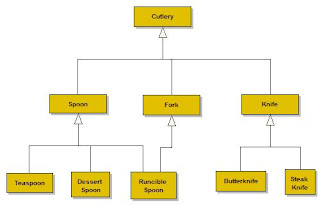
More accurately this is a taxonomy (like the famous taxonomy of species) since we have not shown any detailed facts about our knives, forks and spoons. If we added facts about the shapes of our pieces of cutlery or the purposes they were designed for, then this would be an ontology.
Each level in the diagram shows a kind of real world thing, with facts about it that make it what it is. At the level below, each thing "inherits" characteristics from the thing above it (notice for instance the runcible spoon, which is a long spoon with prongs, for getting pickles out of jars). This is the model of reality that may or may not be faithfully reflected in a computer system.
Now there is a law in England that requires anyone who buys a knife to show some proof that they are over the age of 18. So if you were to create a point of sales system that could flag up when the teller should ask for some proof of age, where would you put that requirement in the above? Against cutlery or against knives? In fact we could extend our ontology sideways to include camping equipment, kitchen utensils and so on, some of which are also knives. Then you could individually identify each of the things for which the law requires proof of age. Or you could simply define a logical union of all the things identified the relevant law, and apply the proof-of-age thing to that.
It may seem that I am being picky here. Why can't the anonymous programmer of some store be a bit vague about how they program their stuff?
The shop that held itself up to such ridicule is no small country store but one of the most mature and well managed of the UK's major supermarket chains. If they can't get it right, what will happen when we start to trust someone less sophisticated, a government for example, with more sensitive data than the meaning of spoons. We are seeing more and more intrusions into our lives by increasingly zealous governments, determined to protect us at every turn, and while few would argue about the dangers of knife crime, we need to insist on a lot more thought about computer systems and data before things continue in this vein. Otherwise we will probably see mistakes of greater impact than someone having to show their age to buy a teaspoon.
Meanwhile the least we can do is laugh at firms when they make these sorts of blunders, whether these blunders are a result of overzealous officialdom or wooly ontological thinking. If laughing at them doesn't work, we may find ourselves march on Westminster bearing the apparently deadly spoons.
Night of the Long Spoons anyone?
http://nannyknowsbest.blogspot.com/2009/04/dangers-of-teaspoons.html
Now why would someone be expected to prove their age before purchasing a teaspoon? Bear in mind this was not some secret Ninja assassin's teaspoon or a giant spoon you could beat someone to death with. No, this was the humble little spoon we use to stir our tea.
To answer a question that someone in the US asked, this was not in response to some law. There's no law in England requiring proof of age for spoons, though there is one for knives.
I don't for a moment buy the story given by the store that someone somewhere was killed with a teaspoon or that this would be a reason to require proof of age. I think that's just an employee making something up rather than saying "I don't know". Quite apart from the improbability of anyone other than Humpty Dumpty being done in with a teaspoon, any store that asked for proof age for anything that someone, somewhere had managed to get killed with, would soon be out of business. Where would we buy candlesticks, lead piping, rope. So I think this is pretty unlikely.
So there are really two possibilities, neither of them very impressive. Either the store is being over-zealous in their application of the law, as often happens in these things, or there has been some programming error. However, As a technical friend of mine pointed out:
Since the message is automatically provided by a computerized checkout system,
there is absolutely no chance that it is associated with that item by error.
This is right of course: computers never, ever commit errors. I'm not being facetious; it's really in the nature of a computer not to make mistakes. What they do do, more often than not, is do things wrong. It's not the computer that makes the mistake, it's whoever set it up to do whatever it was supposed to be doing. The system that asked for proof of age for a teaspoon may not have been making an error, but most likely a mistake was made, perhaps due to inadequate modeling of the data. Maybe for instance the store system was programmed to flag up all shiny metal things as knives, or perhaps all cutlery. Whichever way we look at it, this has the hallmarks of some ghastly ontological mishap.
So what is ontology anyway? Contrary to what some might think, it is not some new buzzword, some Web 3.0 technology. In fact, every computer system has an ontology anyway, whether or not anyone knows what it is or whether it was thought about very clearly when the programming was going on. Every system manipulates data about things in the real world, and so there is some implied view of the real world itself, underpinning the data in the system. That's all it is - there's no magic to it.
The ontology of a given system may be muddled or it may be clearly thought out, but either way it's there. For example, here is a suggested ontology for spoons:

More accurately this is a taxonomy (like the famous taxonomy of species) since we have not shown any detailed facts about our knives, forks and spoons. If we added facts about the shapes of our pieces of cutlery or the purposes they were designed for, then this would be an ontology.
Each level in the diagram shows a kind of real world thing, with facts about it that make it what it is. At the level below, each thing "inherits" characteristics from the thing above it (notice for instance the runcible spoon, which is a long spoon with prongs, for getting pickles out of jars). This is the model of reality that may or may not be faithfully reflected in a computer system.
Now there is a law in England that requires anyone who buys a knife to show some proof that they are over the age of 18. So if you were to create a point of sales system that could flag up when the teller should ask for some proof of age, where would you put that requirement in the above? Against cutlery or against knives? In fact we could extend our ontology sideways to include camping equipment, kitchen utensils and so on, some of which are also knives. Then you could individually identify each of the things for which the law requires proof of age. Or you could simply define a logical union of all the things identified the relevant law, and apply the proof-of-age thing to that.
It may seem that I am being picky here. Why can't the anonymous programmer of some store be a bit vague about how they program their stuff?
The shop that held itself up to such ridicule is no small country store but one of the most mature and well managed of the UK's major supermarket chains. If they can't get it right, what will happen when we start to trust someone less sophisticated, a government for example, with more sensitive data than the meaning of spoons. We are seeing more and more intrusions into our lives by increasingly zealous governments, determined to protect us at every turn, and while few would argue about the dangers of knife crime, we need to insist on a lot more thought about computer systems and data before things continue in this vein. Otherwise we will probably see mistakes of greater impact than someone having to show their age to buy a teaspoon.
Meanwhile the least we can do is laugh at firms when they make these sorts of blunders, whether these blunders are a result of overzealous officialdom or wooly ontological thinking. If laughing at them doesn't work, we may find ourselves march on Westminster bearing the apparently deadly spoons.
Night of the Long Spoons anyone?
Subscribe to:
Posts (Atom)